
It wasn’t TB after all – I was only joking about that – but it was another childhood disease from another era.
Whooping cough: 32 years after I was vaccinated against it, my immunity is wearing thin, and what with the general suspicion of vaccinations and general overcrowding of tubes and buses , brownfield sites, NHS beds and classrooms, childhood diseases are rearing their ugly little heads again, as the news tells us all too often.
So now I am hacking and wretching and seeing stars, and will for the next hundred days hence – the hundred day cough of old would have been a childhood killer, but all it will do to me is shake my bones a bit and make me think again about giving up rollies again.
It passed over both the kids, jabbed up to their eyeballs in their infancy, by way of a fever – in and out of their systems within a day. But I’m more concerned about my colleagues who have been suffering my chokes for weeks now, despite the requisite two days I worked from home, thinking I had the common cold. The only way to stem the infection is antibiotics early on, but since most of these adults will have been inoculated as children, it’s unlikely to be a devastating epidemic, except potentially for those with bumps and newborns.
But my GP’s entirely justifiable reluctance to prescribe antibiotics two weeks ago when I crawled into the surgery, a lurid bio-hazard, bruised of rib and sticky of voice, is symptomatic of another national ailment from which we are all likely to suffer.
That antibiotics will one day be viewed as the most foolish of human follies has already started to be acknowledged, creating as they do an evolutionary arms race in which the drugs, which don’t evolve – not least in the literal sense of the word – or unless money is poured into them, can only fail to keep up.
Already there’s a backlash, and epidemics are likely to sweep the world when our defenses, immune and drug – have been exhausted: perhaps that time isn’t too far away. Without extinguishing the bacteria entirely, antibiotics are only fortifying them whilst failing to enable our genetic immunity the chance to catch up. Because that requires people to die.
Evolutionary pressures means that all we do as a human race to protect ourselves ends up kicking ourselves in the face further down the line; as we lose our ability to naturally conceive, feed our babies, or die from illnesses that would allow our immune systems to evolve against them, we are storing up trouble against future Armageddon .
Take this as an example: if babies with heads too large to exit the pelvis continue to be born by caesarean, pity the woman 400 years hence, big headedness embedded in her gene pool, who has to suffer the agony of labour and inevitable death because surgery isn’t an option in a post apocalyptic world (or just a world where our medical resources are too strained to cope with the number of big headed babies being born). Or is it just me who worries about how future generations will cope with the genetic mutations we’ve cultivated altruistically?
So, without getting Third Reich about it, I do think we need to be wary that our reliance on medicine and science is harming as well as healing and that short term cures may well cause long term catastrophe.
There’s no way Jonah would have survived in the wild: his nocturnal roars would have had him feasted on by tigers, or more likely, foxes in our neck of the woods… and I do sometimes wonder about Aspergers in the gene pool, with its stereotypes of malcoordination, social awkwardness and later on, typically, depression – although I guess it’s socially selected against for all those reasons, but in a computer literate age, being on the spectrum may well be a competitive advantage, if Jonah’s coding skills and the UK’s drive to be a technology hub are anything to go by.
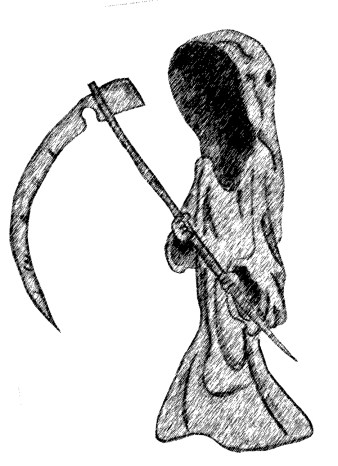
Death needs rebranding as the sculptor of species – including our own: perhaps that is why he is always depicted with a scythe? Without death to shape us, we become flabby and weak in our reliance on science and technology to sustain us – and can it always sustain us, or will it end up pushing us off the cliff in the process? But then, I have always been a bit of a Luddite.
Like any mother, I would hate to face the heartbreak of childhood illnesses, let alone have to cope with a loved one’s early death, but is own insistence on the sanctity of human life above all else making us myopic about what our reliance on science may do to our children’s children’s children?
Okay diatribe over. Next week, I will move on to why there’s no such thing as bad behaviour, only bad situations; how the market rules, okay; and if you’re really lucky, I might get on to why kids should be allowed to do what they want – and one day I might even unleash my theory on why most parents spoil a child in the first six weeks. But right now, I’m not up to the backlash.
It’s my soapbox, you don’t have to listen. Now I’m going to go and cough my guts up some more, but it’s fine coz they sent me home from work, so the only ears I can offend are my kids’.
Discover more from Looking at the little picture
Subscribe to get the latest posts sent to your email.
