
With one in 66 children now being diagnosed with Autism Spectrum Disorder in the US, it’s high time, we got some facts straight about it. ASD is not caused by: bad parenting, vaccines, cocaine, alcohol, mobile phones or proximity to electricity pylons.
ASD is a condition which starts in the womb – according to a new study which came out yesterday, the same day that it has been revealed that new diagnoses of the condition have surged by some 30 per cent in the US, a condition which has been found to have both genetic and environmental factors.
What may be causing an increase in diagnoses is not known. But the surge is most likely to come as a result of wider categorisation of the disorder and better diagnostic tools.
ASD is diagnosed approximately twice as frequently in the US than in the UK. At the time of my son’s diagnosis here in England, cases of Asperger’s* (a milder form of ASD) are found in approximately 1 percent of the UK population.
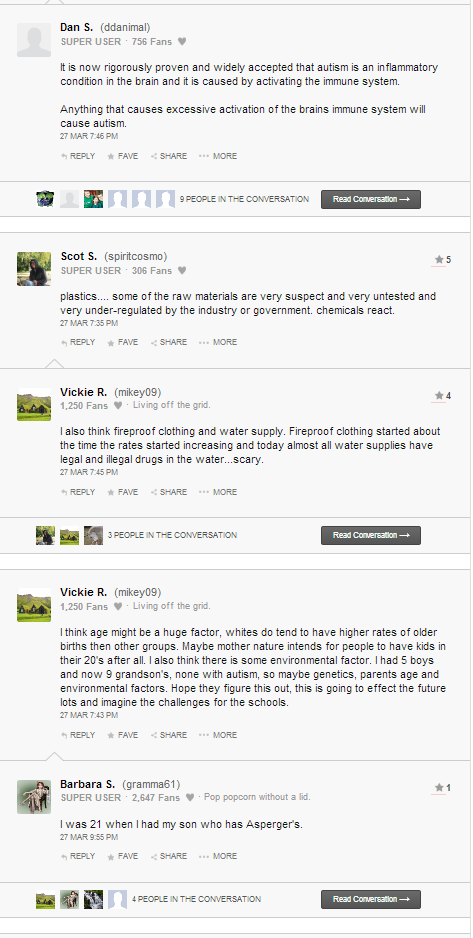
But the fact that the medical profession remain inconclusive about the causes of ASD, and its apparent increase, hasn’t stopped the speculation mongers from gathering their entirely evidence-free opinions and airing them in an dangerously ill-educated manner.I refer you to the above screen shot from this article from the Huffington Post. Comments that appear to have been removed since yesterday ran the gamut of ignorance, from suggestions like, “spanking naughty children” will “fix them” to the oft cited idea that It parents are increasingly looking for an excuse for their children’s misbehaviour. One even raised the old 60s chestnut, the “refrigerator mother” hypothesis from it’s well deserved grave – that lack of maternal affection causes ASD’s classic symptoms of withdrawal. This is of course, absolute nonsense.
Factors that may play a part in autism seem to occur in early pregnancy. It appears that parental age, lack of vitamin D, tertogen exposure or even pre-natal virus exposure may be co-risk factors to genetic tendency, but it seems likely that a complex interplay of circumstances may be responsible, perhaps accounting for the broad ranging nature of this spectrum disorder, but as I am not a medic, I’ll leave it to Wikipedia to speculate. Regardless, the evidence seems fairly inconclusive.
But I reiterate what I have previously written before about my own concerns about my antibiotic use prior to, and during the first weeks of pregnancy, and my concerns about my son’s Asperger’s. This website by Dr Brian Udell supports a belief that overuse of antibiotics in the population may have an effect on ASD, in particular because of the effect antibiotics have on gut health and the links between ASD and Gut health. But I can’t stress enough that the only reason I have gravitated to this theory is that it supports my own experience, detailed in this earlier blog.
I will end with a brief update on that blog, which questions whether probiotics can help behaviour in ASD cases. Taking advice from my nutritionist friend, Anneliese Setchell of Tonic, I tried Udo’s Choice Junior Probiotic Mix with Jonah, which isn’t cheap, (and I’ve not included a link here as I don’t want to appear to be selling anything), but Anneliese isn’t a fan of yoghurt drinks like Yakult which contain sugar or sucralose, a sweetener which may have the effect of destroying the very gut bacteria the drink claims to reintroduce. She also recommends the GAPS diet to support gut health as detailed in my previous blog, but I am a realist and just do my best to give Jonah a varied, nutritious diet, which is itself no mean feat. (Be aware, the GAPS diet also has its opponents too, to which I have included links in the interests of balance, and because of my own initial and continued scepticism)
However, after taking the broad spectrum probiotics fairly often – every other dayish – for a couple of months, in my opinion, Jonah seems calmer and more focused than previously when he has them regularly, particularly if he has been to a party and eaten lots of sweet foods. The same goes for fish oils (Anneliese’s recommendation: Eskimo). The effects aren’t instantaneous, but I can’t see that they are doing him any harm. But good diet, regular sleep patterns, positive reinforcement, routine and letting him do what he likes within boundaries have all proved to be a good day to day rule of thumb for encouraging Jonah’s best behaviour – and probably good guidelines for any child, not just those with ASD.
My aunt, whose grandson is diagnosed with autism, started giving him Yakult and fish oils following my earlier blog on antibiotics, diet and autism, and reports that he hasn’t suffered as many tummy aches (he previously suffered from gut problems and diarrhoea,) and his behaviour has been calmer – perhaps due to fewer tummy aches?
This would would seem to support a theory that gut health (and what we put in our guts) plays a part in regulating ASD behaviour, but can’t provide a cure.
But the upshot is that there aren’t any miracle cures for ASD or any definite proof of definitive causes. But early intervention has been reported to improve the outlook for cases, and I hope my experience with diet may be a little bit helpful for anyone hoping to improve things for their own child with ASD.
I’ll leave you with the other autism related stupidity that I came across today, a link to Talk About Autism’s thread called, “You know when someone doesn’t know much about autism when…” which documents the general lack of awareness, semantical hiccups and downright stupidity that some people display about the condition. Some of it is funny, some just sad, but it’s all enlightening.
*Please note: ASD is now an umbrella term for Autism Spectrum Disorders conditions ranging from Asperger’s to autism in the US. This means many individual labels have now been dispensed with in the US, but are still in use in the UK, hence my son’s recent diagnosis with Asperger’s – a condition which no longer “exists” in the States, but has been gathered up in the umbrella term of ASD.
Discover more from Looking at the little picture
Subscribe to get the latest posts sent to your email.

Wonderful post, it is so annoying trying to sift through all the misleading and incorrect information out there! It is definitely time to separate fact from fiction!