
Deputy Prine Minister Nick Clegg has all the earnest do-gooding social frustration and self-regard of a pulpit preacher. Turning up fresh from Prime Minister’s Question Time for an audience with Mumsnet, he was given a rather more polite reception, he joked, but soon enough, the handbags came out.
Slightly less handsome in the flesh – acne scars, rumpled suit and quelle horreur, Just For Men – he is no doubt drained from the campaign trail. Yet he was a far more polished politician than I previously gave him credit for. And he does deserve credit. Under difficult circumstances you can’t doubt his commitment to helping the less advantaged. But for all his talk of rescuing the NHS, extending free childcare, improving access to funds for students, he notably wobbled over one key question. Child abuse.
Asked why he had failed to back an inquiry in the first place, then supported the notoriously ill-chosen Fiona Woolf to head up the inquiry, who stepped down over her connections to shamed politician Leon Brittan, there was not an answer he could fudge that could cover up his discomfort over the question.
Up till that point, where I had been feeling, perhaps he is not so bad as the rest of them. But this particular answer gave me to believe they’re all in it together, by which I mean, not in it with us.
Stating baldly that he didn’t believe a cover up existed, and that despite the scale of the abuse, there was no widespread knowledge of institutional paedophilia (something of a counter intuitive illogicality, surely?) this was the one question, asked by Kirsty-Anne Jasper, a literary student from Greenwich, to which he could not give a full and coherent answer.
At the times detailed yet somehow evasive, giving obsfucatingly full answers to each and every question, he outlined what he has done to secure the futures of the dispossessed: raising income tax brackets for poorest, rescinding tax breaks for the richest and protecting civil liberties for all. All of which makes for great sound bites, but with only 8% of parliament seats occupied by Lib Dem politicians, he had no choice but to be fairly was fairly honest about the difficulties he faces influencing policy decisions.
In all, he seemed to be basically a nice guy trying his best with good intentions, but lacking the muscle to pack many tough punches. In the main, I felt his policies were fire fighting and failing to get to the crux of the issue. Better mental health provision is great, and more equal pension policies for women are all very well, but it felt like the root causes of society’s problems were somehow too big to grapple with.
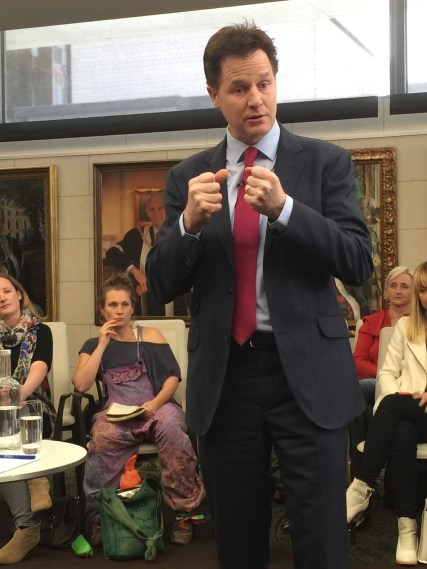 My own question, about better support for mothers at the heart of a better society, with universal state maternity provision and free childcare for mums wishing to return to work was well-received, but taken as part of a quick fire round of questions from the floor, rather than approved by Mumsnet in advance, there wasn’t enough time to answer it properly.
However, like the compromises inherent in a coalition, the nature of society is that not everyone can get what they want all the time, especially, it seems Nick Clegg. Asked whether he’d rather form a government with Labour or the Conservatives, Clegg offered a pat response – he’d rather be Prime Minister. And sadly, because I do genuinely think he’d make a better fist of it than the other main opponents, he knows only too well it ain’t gonna happen. A single party state is dead, he said, somewhat defeated.
And when asked whether he felt personally responsible for the demise of his own party during his time in power, his personal frustration bubbled to the surface, saying something to the effect of “it’s not my fault I’m in power in the middle of such an economic shit show.”
Personally, I think Clegg’s basic humanity provides a vital check and balance to the rampaging cruelty of the Tories’ free market hellhole. He noted that today’s culture of economic sanctions for the most vulnerable were a bit “trigger happy” (not so happy for the poor souls involved) and mentioned a traffic light system that’s been trialled which gives people a second chance. However, he stuck to his guns about the fact that people in receipt of government money should expect “strings attached”. However, to this I would argue that, with a population puppeteered by austerity, some of those strings are wearing pretty thin for many people, and their multiple challenges should be taken into better account. Sadly it seems, as always, society’s most vulnerable are open to abuse by a system that’s geared up to protect the powerful.
In any case, it was clear that, while Nick could talk the talk, for the most part, I got the feeling that, as far as the corridors of power are concerned, sadly, he’s more often sat on the sidelines. But given the horrors that have allegedly taken place in them over the past decades, perhaps that’s no bad thing. Though what he may have overheard there is anyone’s guess.
Discover more from Looking at the little picture
Subscribe to get the latest posts sent to your email.
