

Forgive my ignorance (and I rarely think it wise to get involved in something of which you are largely ill-informed), but growing up, I guess I thought we had the race thing more or less cracked. I mean, I went to school in 1980s Kent, where a shade other than lily white was always going to be a minority, but venture into the capital, or watch CBBC, and a rainbow of faces was increasingly the norm.
When I grew up and moved away from the provinces, East London, where I settled, seemed a veritable racial idyll, where we all rubbed along cheek by jowl in relative harmony. After all, we had friends from a range of backgrounds, although these backgrounds tended to converge at uni, work or through friends of a friend.
When my children were young, I was proud that a person’s colour never cropped up as a subject for conversation and their friends came in a variety of shades and origins. But now I come to think on it, those diverse shades often came with class-lines firmly attached. The mixed raced daughter of a woman who looked like me and her banker husband we met at antenatal classes; the mixed race son of a woman who went to baby singing, whose husband runs a plumbing business locally – there appears to be a running theme, though not for want of trying – we chatted eagerly to the black dad of the kid who turned somersaults at football, marvelling at his superior agility to my knock-kneed pair; the mum of the boy with braids who could beatbox as baby; inviting their kids to parties, but not without a second thought: in the presumptive ideal we might instil cultural understanding and friendship with people the like of which my husband and I, in our suburban miasma, had rarely encountered as children.
Yet, even their childminders, in this diverse part of the world, though I was happy to accept applications from anyone who’d take them, who could speak good enough English to be understood by them and by me, tended to be middle-ish class and white, though perhaps from Spain or Poland or even Lithuania. The woman in a burka who once applied, who lived not far from us, made me feel uncomfortable. I couldn’t find the wherewithal to be patient or understanding.
For me, it was prerequisite of the job that my kids could see the face of their carer, so she didn’t stand, I’m sorry to say, much of a chance, though they were used enough to the salwar kameezes of the ladies from the local Surestart centre. But as the kids got older, they, by and large, ended up with a group of friends who were a bit like them. These things run deeper than simply making the effort to reach out. The concentric circles of our lives grow tighter as we get older, and we grow lazy, accepting the shorthand of old friends and acquaintances who live close by, and casual help whose cultural mores we find easier to understand. And there’s not a lot anyone can do about that.
Now, I realise whole streets and regions even within the same postcode are rather more diverse, perhaps even ghettoised, than some. These days, now I’m no longer fresh to the property market – when any old crack den would do, the white people I know live in loft conversions and Victorian terraces or above shops, in house shares. There are still the old guard of East End working-class white, but their numbers are dwindling. More often the darker the face, the likelier they are to live in a high rise. I’m not casting aspersions. It’s sadly true. It’s easy to think these things are down to something other than just probability: some inherent skill other the one’s family’s ability to drag one up the ladder of social mobility, but it’s not. It’s an uncomfortable truth and many of us either fail to notice since we are unlikely to venture much further than our personal comfort zone, or would rather look the other way than admit we are profiting from institutionalised unfairness, just as our families have done over the generations, whether intentionally or not. And so race has become the elephant in the room, where white, middle class people are too afraid to talk about it in case they say the wrong thing, working class people who express their views on heated topics like immigration are branded racists, and so by saying or doing nothing, we tacitly accept its prohibitions to others.
It with trepidation, therefore, that I waded into the debate on Sandra Bland, the black woman who died in police custody over an alleged traffic offence – only writing about it because I’d had a run in with the law, and so I felt able to draw diverging parallels with the video of her being so disabused of her rights by a law enforcement officer on my Facebook feed the next day, where, in similar circumstances, I had simply given as good as I got and bolted off scot free. It might seem idiosyncratic for a white woman to speak out about racism, but no more so than a man standing up for feminism. In these dangerous, tumultuous times, we can’t pretend it’s not happening, just because it’s not happening to us.
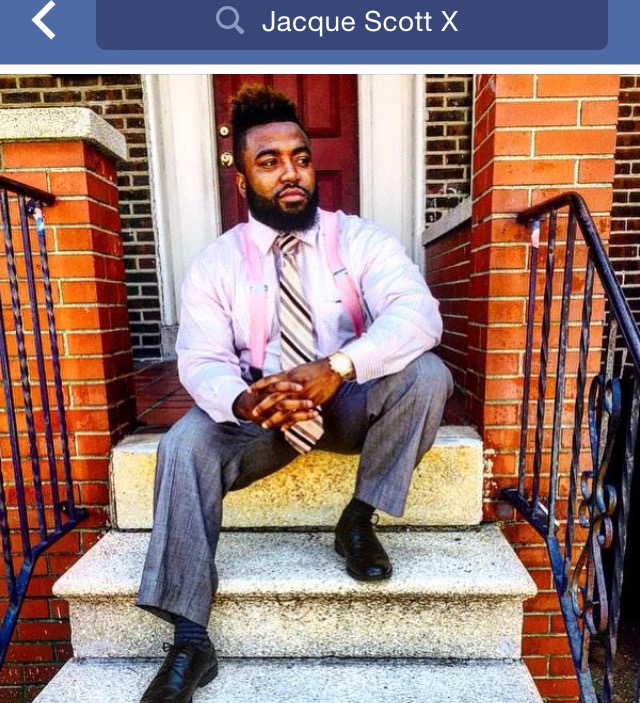
So I felt honoured to be contacted this week by a guy called Jacque Scott, a Delaware immigrant from Ecuador, Brazil, who, in the wake of shocking police brutality directed at black people in the states, such as the murder of Eric Garner, held in a chokehold by police for selling cigarettes and “minding his own business” ; or black teenager Michael Brown in Ferguson, where this week’s anniversary of his death led to peaceful protests turning into riots amid heavy handing policing, with another death at police hands and multiple arrests – as well as lifelong discrimination of his own, he says, for the crime which he terms, “driving while black”, has decided to take matters into his own hands. No, not by vigilante tactics such as those shown by groups of armed white men in Ferguson, patrolling the protesters, who apparently avoided arrest while unarmed black people were wrongfully detained. By setting up an organisation, Newton’s Third Law, so named “because we are the force that’s moving our people and hopefully our country into a positive equal society”, he hopes to stand up to the injustice committed daily in plain sight, which Jacque calls an act of genocide.
Aiming to redirect funding into school systems to make a difference to educational and recreational programs, introducing a mentoring and tutoring program and tackling institutional racism by partnering with local colleges and universities on youth access programs, Jacque hopes to build a community that is no longer reliant on government support, which, he believes is gradually being withdrawn by a power structure intent on crippling those who have become reliant on it, through historical inequality.
It is a noble cause, but one, I fear, may serve to make him a target, for although he seeks his ends through peaceful means at first, though ultimately “by any means necessary”, he is all too aware that things “may start to hit the fan”. Calling on those who “may bend but do not break” even in the face of harassment, prosecution, even putting their lives at risk, he is at least speaking out to a community to whom this has been the norm, for centuries, so like the protesters at Ferguson, have little more to fear. But it’s important other voices, even those who do not bear daily witness to persecution of this sort must show solidarity for his cause, even when they are as faint as mine, and even then the other side of the world.
So, to one man army Jacque Scott and his Newton’s Third Law, I wish you the best of luck in your heroic task, and hope that even though the forces working against you are so very unequal, you are able to cause a reaction that has a positive effect. If anything, it has made me look at my own life and recognise the causes of inequality and institutional racism are, as you said in your eloquent email “collective… with no sole perpetrator” but woven into the fabric of society, reinforced by power structures and collective inaction.
Discover more from Looking at the little picture
Subscribe to get the latest posts sent to your email.
