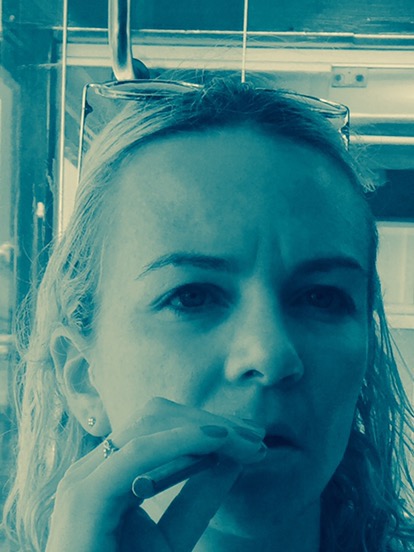
It’s with a degree of irony I noted that Tuesday marked world mental health day, and not for the first time, I’m feeling low. Like the difference between a cold and the flu, feeling down and clinically depressed are worlds apart, but one can certainly follow the other, and having had a day on Sunday where I just couldn’t see the woods for the trees, I know I have to take care of myself to avoid falling off a precipice. This means being kind to myself, getting enough sleep, exercise, nourishing food, sunshine and love I can; thinking about others and living in the present. Oh I know all the tricks. I’ve been living with this, whatever it is, for years.
I had my first ‘episode’ of what can only be described as anxiety aged eight. It lasted six months, which is a long time when you’re eight. Something had happened at school, and I suddenly felt anxious all the time. It was a time in my life where I was realising I was different – unlike my friends, I didn’t have a mum at home who picked me up from school. I had short hair and a spiky personality; I found it harder to make and keep friends, and would upset people without ever really working out why. Suddenly, getting through the days felt inexplicably harder. I worried about the future – things I didn’t really understand yet, like how I would get a job, pass exams, buy a house. And even what had been enjoyable activities – watching cartoons for instance – became marred by introspection as I worried about how on earth someone had made them frame by frame. I became exhausted by worry and withdrawn for fear of getting it wrong.
I know now there is something in my genes that makes me prone to focusing on life’s minutiae. Both my children are diagnosed autistic, and my grandfather was not known to be one of life’s sunbeams. Like a real life Victor Meldrew, he spent his dotage complaining, and no doubt he had plenty to complain about. A bad back and lifelong near poverty had sucked the life out of him, but then I was never there to know whether he ever much get up and go in the first place. All I know is my father was angry at him for something – never trying hard enough to beat his circumstances, unlike my father perceives himself to have done – or taking too much advantage of the kind-natured servility of my grandmother – but he was always unfailingly kind – if occasionally grumpy – towards me.
What I do know is that the medicalisation of the emotional outcomes of one’s characteristics and circumstances does seem to be a flawed way to approach individual unhappiness. There’s no pill to fix what’s societal ills of inequality and injustice, just as there’s no treatment for autism that leads my son’s (and my own) moods to hanging from a knife edge of inflexibility and need for routine and order.
When I go to the doctor tomorrow to talk about how I’m feeling, they may want to tinker with my hormones that leave me tearful and tender two weeks out of every four, but why my mental state has a clear impact on my health, given my tendency to nihilism- to what I call suicide by the back door: behaviours that hurt oneself, like smoking, drinking or otherwise self-medicating – when I am down. But I’m not sure the medical community can offer a quick fix for the health of a mind that has, after all been crafted over years of life’s trial and tribulations and via generations of the same.
Oh yes, I’ve ran the gamut of self-help and cognitive behavioural techniques. I deep-breath, and practice mindfulness with the same self-discipline with which I hoover my carpet. There’s no technique that can calm an eye for detail that will notice a speck of dust or obsess over a facial imperfection, but which also makes me a hawk for a stray apostrophe or poorly turned phrase. What’s made me anxious and stressed has also made me economically viable. My attention to cleanliness and order has no doubt stemmed from being part of a long line of surviving offspring from mothers with the same urge to scrub down unhygienic surfaces in the days of cholera; but, which in an era of bacterial warfare, just makes me anxious. There are parts of me and everyone else that just aren’t built for modern life.
And that goes for society too. I am a social creature, for all I increasingly appreciate my solitude. I long to be with my family and to have accrued status amongst a community that has known and supported me all my life. The sad reality is that, in these days of regular professional upheaval and long distance relationships, my most my vital connection is more often with my phone. I am isolated, screened off at work, and quite often too tired to make time for my community. If modern life is rubbish, my mind has started to accumulate its junk.
Yesterday, my husband reported a second ex work colleague had died in as many weeks. The first, in a stressful role in the banking sector, had drank and smoked his way into an early grave. The second, also in a similarly male dominated environment, had hung himself in his garage after a routine bender. He had a wife and three kids. It put into perspective my latest overdose of one and a half antihistamines, and a sulky packet of ten Marly lights. My self-preservation instinct is stronger than sometimes, I’d like, for all there’s a quiet, insistent death wish, tinged with narcissistic ambition. After all, Society rewards and ruins the risk takers. But there’ll be no posthumous celebration of my work, no head in the oven. Just a quiet ignominy, which I’m already getting used to in life.
And because I’m someone who likes to get things done rather than tell people what to do, to be efficient rather take advantage, I, like so many others are feel as though, in today’s competitive environment, we’re simply losing our way. In a world where I’ve jumped through ever higher hoops for dwindling opportunities, one that rewards the shrewd but not the kind, it’s easy to feel undervalued. There’ll be no posthumous celebration of my work, no head in the oven. Just a quiet ignominy, which I’m already getting used to in life. The political bee-hive of office politics is hard to navigate for those of us built for villages.
So what’s the solution? No, not antidepressants, linked with speech and language disorders when taken by pregnant women; increased violence and suicidal thoughts when taken by teens. In my experience, pills left me zoned out, unemotional but no less unhappy for it. CAT therapy left me increasingly introspective, and concerned about my behaviour and how to change myself. In the end I realised that I was less the problem than everything else.
Perhaps, then, it’s the village that’s missing from mental health strategy – fragmented communities are more likely to suffer, after all- I pity the jungle residents, who may have found solidarity as well as squalour. But scattered and parcelled out across an unfriendly nation and I don’t doubt suicide rates and other mental health problems among these immigrant communities will soar. But what’s the remedy for globalisation?I’m afraid I don’t know, but for all I’m a realist at heart, I suddenly long for something like religion to anchor me to some unifying purpose in the absence of a close knit family unit, or community I feel at the heart of.
Discover more from Looking at the little picture
Subscribe to get the latest posts sent to your email.

This is a great piece Chrisi.