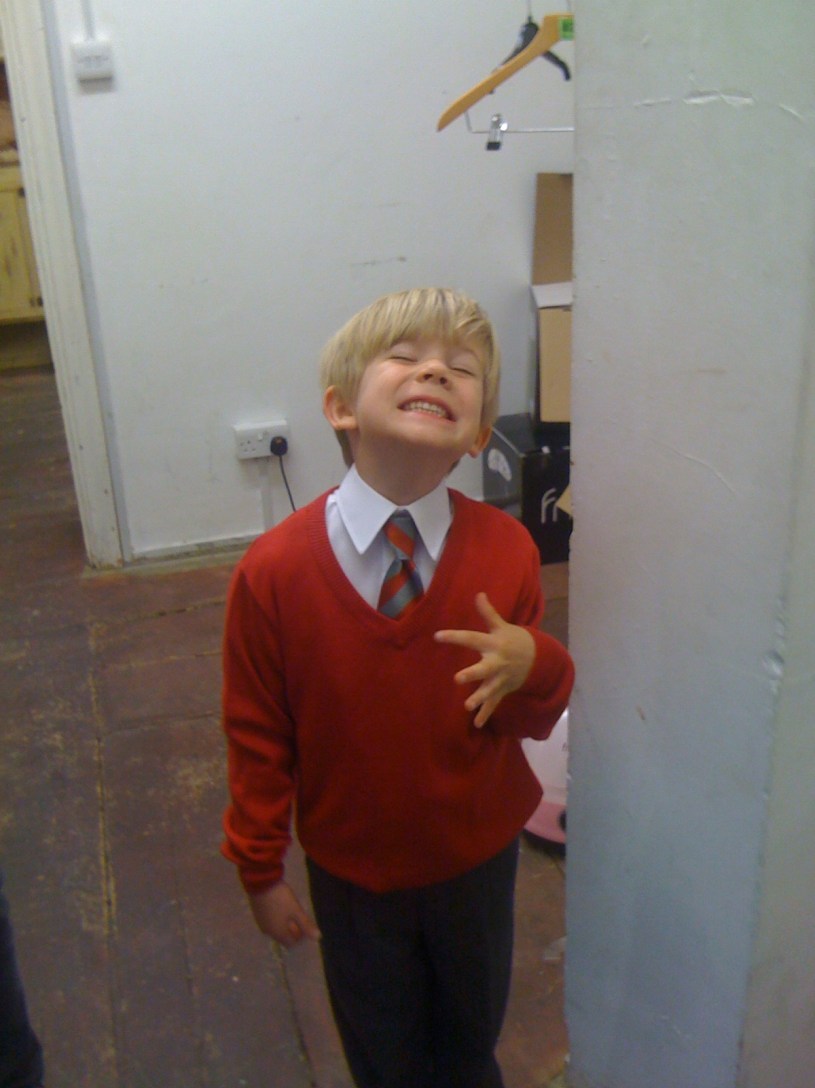
It’s a fact relayed to me by one of my nursing friends that one of the biggest indicators for oppositional behaviour is strict parenting. I had a relatively strict upbringing, and when I rebelled, it was fairly spectacular. Indeed, I’ve written before about how my father’s unwillingness to let me grow up led to a five year career in the, um, adult entertainment industry and let’s say, an ‘intimate’ piercing, just to get my own back on him telling me I looked like a tart when I got my ears pierced twice.
It’s a trend I’ve noticed with friends with difficult childhoods who’ve long since left the years of teenage rebellion, and among the kids of friends who’ve adopted more disciplinarian parenting methods. Those with strict parents rebel hard, and those with the strictest are still rebelling well into adulthood.
When my son, aged three or four, started to exhibit signs of oppositional defiance (as most pre-schoolers do), I quickly realised the surest way to create tension was to insist on having my way all the time. Letting him have his way, at least some of the time, meant there was absolutely nothing to fight against, and so, in time, he gave up pushing.
With two kids diagnosed on the autism spectrum, I recognise my own tendency to inflexibility, no doubt handed down to me by my own parents and passed down to my kids. It took a massive cognitive leap to recognise that a looser leash and a more childcentric approach to my own parenting might produce better results than my own childhood’s focus on good behaviour, manners and excellent school reports – and indeed the expectations that I would look a certain way.
The Laura Ashley dresses of my childhood- my father’s way of domesticising his new found affluence – brought so much mortification to my six-year-old self lest I see classmates around town wearing neon, may have been chicken or egg to my adolescent self-consciousness.
By not allowing me to wear bras or indeed anything even vaguely sexy when I was older, the inevitability of my all-out early adulthood rebellion was sealed.
In the way many of us replicate the mistakes of our forbears, and add a few of our own for good measure, it was the same with my own kids. Like many parents, I wanted my children to have a certain ‘look’ when they were little that reflected my personal aesthetic – preppy tee-shirts for my little boy, Jonah, rather than head to toe Thomas le tank.
For my little girl, Ava – well, I’d kinda decided by then I didn’t mind a frilly frock so much, after all, although I was fairly OK with vintage dungarees, and not so big on sequins.
It soon became clear my daughter had other ideas. Rather than face the battles I’d had with my own father about wearing clothes he’d spent a lot of money on, I did my best to back off.
I only stepped in when my daughter clearly comes downstairs looking crazy, is definitely going to get cold, or is making a fuss about something she previously chose to buy at the shops.
That’s not to say we still don’t have the odd battle about clothes as much as anything else (we’ve compromised on me making a suggestion if we’re going anywhere nice and letting her do her own thing the rest of the time). I recognise going at loggerheads over it might have painful consequences much further down the line.
It’s counterintuitive in many respects – to allow your kids to make bad decisions, like wearing a tutu to a farmyard, or eating sweets until they are sick – to help them make better choices in future.
Doing so means they make their own mistakes and learn from them, rather than get stuck in a trope of oppositional behaviour that long outgrows the behavioural stage.
Much like ignoring behaviour I don’t like and encouraging the behaviour I want, it works so well that most people, most of the time, struggle to understand why my children are diagnosed on the autism spectrum at all.
If only I could apply this logic to hardline school uniform policies. Currently, my kids go to school in zero uniform, and thank the lord for that.
Even with this mandated lacsidasical approach to schoolwear, we’ve had our challenges over shoes and clothes due to sensory issues and a general obstinacy regarding wearing anything I think looks nice.
After years of struggle in the mornings, we enter years three and six perfectly capable of tying shoelaces (on trainers), and generally looking reasonably tidy, if not always very coordinated (and to be fair, I recognise I suffer a little from the urge to hyper-coordinate, which isn’t fair to put upon my kids). As long as they are suitably attired for the weather, that’s as much, I believe, as is required for a day of learning at any age.
Which is why I rankle at this week’s news stories of pupils being sent home for minor school uniform transgressions, skirts being measured, girls sent home for ‘distracting’ shirts, and other draconian measures of army –style uniform inspections.
Given my own oppositional tendencies, determination to be treated as an individual and past career, the idea that someone could look me up and down, and shame me for my personal choices feels more than a little unhealthy. Regardless of a lack of evidence that strictly adhered to uniform policies improves educational standards (schools in high performing countries like Norway don’t wear uniform as standard), I can’t help but feel schools are picking the wrong battle with this one.
The teenage years are meant to be years of exploration: discovering individuality, tribalism, and generally working out who you are. To insist on uniformity is to stifle a very important part of teenage development.
This aside, there is good evidence to suggest that if you do hamper this development in any way, rebellion ensures. I remember my own tongue stud as an ‘up yours’ to a father who shamed me for getting my ears pierced. It hurt a lot,and actually looked terrible, but I still did it to assert my independence from him.
Teenagers are learning to define themselves and that means being able to do what they like, not just want their parents, or schools for that matter, want. I suspect the upshot of all this uniform policing will be a university career spent with exceptionally unfortunate haircuts and array of unsuitable tattoos – even more so than my own generation, whose nineties ‘school uniform’ of DMs and army jackets didn’t actually move on that much when we all moved out of home.
History bears this out. Post-war austerity is always followed by an explosion in fashion creativity, as stifled individuality is no longer so strictly rationed – the roaring twenties and swinging sixties all pay homage to that.
Non-conformity is always a rebellion top unreasonable expectations that everyone should be the same as everyone else – so much so that, ironically, it often ends up with a conformity all of its own. Take the Punk-movement, for instance. Policing what people wear, from burkhinis to bikinis, feels like another example of the Establishment telling other people what they should look like to be acceptable. And none of this washes very well with me.
Discover more from Looking at the little picture
Subscribe to get the latest posts sent to your email.
