As I hurtle towards my mid-thirties, the drip drip drop of friends and acquaintances taking the plunge into parenthood has become a deluge. In my circle of uni friends, most have sprogged, are sprogging, are thinking about a sprog or have a dog, which they have turned into a pampered substitute.
The ones who haven’t partnered up are increasingly looking like career singles: slightly louche at parties and banging on self-importantly about their jobs. Dinner parties have become a barrel of Bridget Jones style clichés, particularly in the rather more upper middle-class of my circles. And I must admit a wry smile to myself as once easygoing young uni mates become new parents bouncing recently gestated infants vigorously over roast lunch, wiping away the inevitable proliferation of spit up while keeping up a merry stream of dad banter with the sleepy enthusiasm of one who hasn’t yet twigged they’re running a lifetime’s marathon.
It’s not that I’m bitter that I’m no longer in the baby haze – no, I’ve taken the executive decision never to go down that merry path to martyrdom again, and am happy enough to skip off into a free and unfettered forties, unencumbered by miniature slave drivers, even though I may yet look back in regret at the other little people I might have made. Given that I was first of the bunch to become a mum, I garnered more than my fair share of congratulations and concern in equal measure, at least first time around. But re-wind the last ten years, when it came to acknowledging my child in the flesh, rather than just as a vague abstract concept, most of my friends “from before” – and I do say most – were resolutely indifferent.
I know it’s difficult to be interested in other people’s children. They can be boring, noisy, juvenilely rude and also not much interested in engaging, so busy are they managing their own bodily functions. But it’s worth the effort to develop a relationship with the next generation. They rarely forget you if you turn them upside down, even if the memory is hazily furrowed down the telescope of relative time.
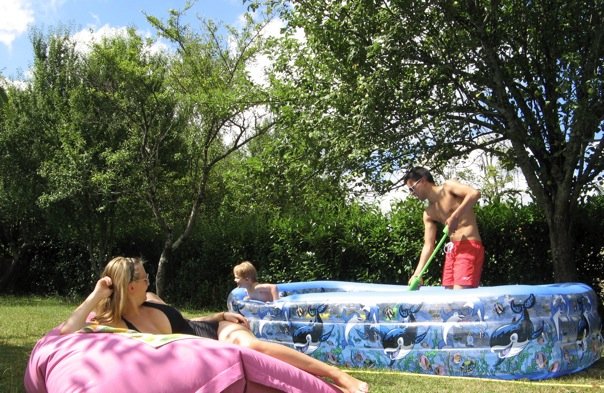
Six years ago, the same group of friends who ate roast lunch yesterday at The Albert in Battersea Park (very nice, even more dog friendly than child friendly) went to stay in one of the group’s parents’ house in France. It was idyllic, if, for me tinged with sleep deprivation and late pregnancy ennui. But while my unencumbered friends sat round over hearty pot roasts and bottles of red wine and enjoyed lazy lie-ins, I perfected my scarf knitting technique sat on a beanbag with a head torch, casting off my anxieties about Tom’s recent job loss in a frenzy of purl stitches, getting up early to deal with a tantrum and push Jonah on a swing.
The others were interested enough in my pregnancy, especially the girls, and to the toddler I tried to keep as well away as possible they gave the time of day, though failed to develop the relationship much beyond a pat on the head, or a tolerant game of tiddlywinks. But one (let’s call him Bob), was less self-conscious in getting down to Jonah’s level, playing many an avuncular game of water pistols. Jonah hasn’t seen him in years, but when he sat down two chairs away, (the non parents and parents sat a careful distance away down at the other end) now the father of a three month old, (“it’s easy” he jested, wiping away a profusion of spittle) Jonah remembered him, and said an awkward, nine year old hello.
It really can be that easy to form a worthwhile relationship with your friends’ children, even if theirs might comfortably sit a generation above or beneath your own. Babies grow up in the blink of an eye when viewed from outside the nest, and those indulgent new parents will become weary-eyed as their infants are joined by less-indulged latter siblings, and tire of the inevitable chatter about milestones and sleeping routines and dichotomies about whether purées or baby-led is best for weaning (you’ll do a bit of both anyway), just as I have. But it is a golden window of opportunity to get to know them that very quickly slams shut.
Now, as my friends become parents, they form inevitable relationships with similarly gestated infants of others, yet still have little more than a passing avoidance for my infinitely more socially acceptable offspring. Now 9 and 6, they are fairly capable of holding a conversation and definitely able not to shit their pants, and could in provide willing entertainment to slightly older versions of the same babies (or even perhaps offer them a job one day) in as much time as it takes for us to organise ourselves into the same venue again in a year or so’s time.
In the meantime, I will try my best to be patient as they talk about parenting ground that is new to them, without trying to give advice – even if it may prove worthwhile; and I will listen to their stories of being puked up on in the car, while trying hard to bite my tongue about the times I heroically cleaned up vomit or changed emergency nappies en route to sophisticated pub lunches when they were still an urbane twentysomethings and I was a young mum, while pretending I was coping amazingly and all was rosy when it wasn’t.
For those who are now past the watershed of birth, your tired eyes betray they are already more understanding of the seismic shift that has occurred, and that life, or at least your vagina, will never been the same again. I will give you a break from holding their baby when your arm is tired, and I will discreetly look away as you fumble with their tops for a feed without making them feel awkward, despite sometimes feeling I had to sit, a la Farage, in the corner, so as not to draw attention to myself in a room full of non-parents back in the days when I was breastfeeding. But I will also guzzle three glasses of wine just because I can, because, when I was a new parent and you weren’t, that’s what they did. And you, no doubt will feel slightly martyred and superior, just like I did, because what you are doing is soo much more fulfilling than getting pissed at the weekend, even if you are also sightly jealous of my relative freedom. And for all the times my other half has valiantly entertained the kids so I can grab half an hour of much needed adult conversation, I will try and spare your partner the same indignity, even if sometimes it can’t be helped.
But I would ask that, now you are parents, please try to engage with my kids a bit more – I know they aren’t always that up for chatting, but if you get down to their level, and didn’t pretend they weren’t there, they will find their feet with you. And I will do the same for yours, if you let me, even when they are at that really annoying stage of being a toddler and probably, with the benefit of hindsight shouldn’t be brought to a pub at all.
Because parents – and their children are people too. It doesn’t mean they should automatically be denied sophisticated activities (tea at Claridge’s springs to mind) or pigeon-holed into “family friendly” activities. Parents shouldn’t be or seen but not heard, and it’s tough luck for those in the market for a quiet pint, or crustless sandwich. Children are a part of life, not a brief anomaly in an otherwise self-involved existence, and the more we try and distance them as adults, the more we feel we need to do the same with our own when we become parents ourselves.
It’s my belief that no one really grows up until they become a parent (this is no criticism by the way: most of the best people are children, though kidults can be a terrible bore). When they do, it can be a shock. We can all do more to soften the blow by being more tolerant and welcoming to parents and their children, whoever they happen to be. Especially old friends “from before”, its worth making the effort with the next generation, you never know a little investment of time might start to pay dividends.

Discover more from Looking at the little picture
Subscribe to get the latest posts sent to your email.

Interesting read, but a bit sad too. I wonder if this a London thing, and to do with the fast London life? Like you I had my children before most of my friends did, and now have a 9 yr old and a 12 year old whilst many have toddler and babies. I have always found people to be extremely kind and friendly and chatty with my children. Just now I have walked the village with my 9 year old and our dog, and people talk to him as much as they talk to me. Living in a village community means we all know each other’s kids, and we often socialise with children in tow. I do hope I don’t come across as too smug, but I really wonder if this is to do with living in a big city where life moves faster. Or maybe you have the wrong friends, nice people but too self absorbed?
Thanks for your comment. I agree that London can be a bit insuler, but i do thibk it’s more of an age gap problem. Most of my friends just weren’t thinking about kids when i had them, hence their general awkwardness. I hope, now they have – or are having- their own, they become a little more engaged and understanding! And not just with kids the same age as theirs!
I think it is also reflective on the number of single children in that generation – no siblings to practice on or realise that they do have good convo skills. I have a bright 9 year old, she can have a good discussion on a range of things from the news, to books at GCSE level (yes really thats where they place her literacy skills at the moment), to baking and master chef (esp MC Australia) or just life in general. She has always associated with adults (I am the eldest of 6 and was 38 when we had her) and the first grandchild in a large family. She loves children and will happily entertain other peoples kids for an hour or so.
I agree with this – plenty of people with only children (or more) rely on other adults to give them a break from entertaining their kids from time to time – interaction that can’t always be provided for by family members in this day and age – and it’s always appreciated both in terms of the help it gives but also the role models other adults can provide. It can be richly rewarding for everyone – kids and interested adults where they are prepared to put in a little time.
I have mixed feelings about this post – on some levels I agree, on others I don’t. While I appreciate people who engage with my children, I don’t think it’s something that everyone is capable of, or interested in doing. And that’s ok – some of our friends are people I just like engaging with on a grown up level. Others are more like family to the whole family. It also depends on context – if I see a friend I haven’t seen for a long time, I am quite likely to be more interested in catching up with them than in playing hide and seek with their toddler.
I had mine a bit before most of our friends as well, and it is frustrating trying to still take part in twenty something activities while dealing with parenthood, but that doesn’t mean those friends owe me some kind of debt to talk to my children. I remember as a child that some grown ups were nice, and some were really fun, and some were a bit distant and hard to understand – that’s life though, isn’t it?
Hi there, yes, I actually agree with you a bit too on this. But I guess what I’m feeling is more to do with the fact that a lot of them are currently having children, and are so wrapped up in their baby, it’s hard not to feel a touch of schadenfreude for all the times you felt your feelings about the situation when you had a baby to deal with weren’t sufficiently empathised with. I guess, from experience comes empathy, so perhaps I expect too much. But I feel that perhaps it should make them realise that their babies will be kids too one day, so it might be nice to put in a bit of effort in order now with mine to reap the same treatment later on for their own.
I totally get that, and it’s true that noone gets parenting until they have their own. And people with their first child are totally wrapped up in that feeling that NOONE HAS EVER EXPERIENCED THIS BEFORE AND OH MY GOD IT’S SO AMAZING AND IT’S ALL ABOUT US – and quite irritating sometimes. I’m sure I was! 😉
I’m continually amazed by how interesting and fascinating I find my children as they grow up, so I do want people to appreciate them. But speaking as someone who is generally rubbish with children that aren’t my own, I know that I’m awful at the toddler years – good with babies, and great from about four/five, but pre-schoolers are tricky, so I am a bit guilty of not engaging with small ones. Just as with my grown up relationships, I tend to have a small band of children (friends’ children, my children’s friends) that I get on with very well and our relationship develops slowly over time and repeated exposure, and is a real pleasure. Other people are less introverted than me and better at developing relationships more quickly, I guess!
Thanks for your comment. Yes, I can see that too. It’s difficult isn’t it? Some people are just naturally drawn to kids and others aren’t – so I have to be more understanding of that.
I’m much better with older ones too. By the time I was done with the baby years, the sight of a random toddler coming towards me arms outstretched with a soggy biscuit in hand began to fill me with horror. But I’ve always got time for little ones of people I know…perhaps that why I hope for it in return.
I think the main problem is one no-one likes to acknowledge – other people’s children aren’t that interesting. Unless they’re the same age, and then it’s mainly to compare them. You’re not particularly interested in your friends’ new children, as they’re at a different age to your own, just as they can’t relate to yours.
I find my own son endlessly fascinating (and have grudgingly accepted that others may not find him quite so thrilling) , and because he’s five can also relate to other five-year-olds, but have entirely forgotten what to do with two-year-olds, and am frankly scared by older ones as I think I’ll bore them, or not understand when they go on about Minecraft.
I agree with this to to a point, but then we might as well hold our hands up as a species and say that people aren’t interesting unless they are doing the same things or can help in some way. Which is human nature, but it us slightly reductive and not very idealistic.
God you sound pompous and stuck up
Well, we all do sometimes.
As a happily childless woman I agree with a lot of your post; I really valued friends of my parents who took an interest in me when I was a child, and now i am enjoying getting to know my friends’ children in my turn. It’s a relationship which can be very satisfying for all parties.
However, this:
“It’s my belief that no one really grows up until they become a parent (this is no criticism by the way: most of the best people are children, though kidults can be a terrible bore).”
suggests a level of contempt for childless people that is pretty hard to take. Fortunately I don’t think my friends feel like you!
Sorry, just my opinion. Not everyone, obviously, but many…
Have you ever, for one small moment, considered WHY people might not have here interested in children (yours included). Some (like me) had great turmoil over whether it gave children or not. There’s a lot of back story to this btw – but so too for many other friends who have stayed (or been forced to stay) childless. The only way to cope was by distancing. Have some sympathy for those who don’t engage with kids – it’s not always what it seems. (I have a kid now btw and am always v considerate around my child free friends and would NEVER expect them to engage – it’s a joy when they do of course.) sorry but your self righteous post has touched a nerve.
Well clearly! I’m mainly talking about people who are now having children. I wonder why my post has bothered you so much?And why wouldn’t you engage with other people’s children simply because you are struggling to conceive? that strikes me as a bit unfair, whatever your personal problems might be, it’s not your friend’s fault, or their kid for that matter…
And this is slightly missing the point. This is about being human, rather than only being interested because you are at the same life stage. Not about projecting your own feelings onto others, especially children, which seems a bit unfair. Granted, some people are just not interested in kids, but why only be interested when you have or are having one of your own? Seems a bit narrow minded to me.
Might not have been interested… (autocorrect first line)
“The ones who haven’t partnered up are increasingly looking like career singles: slightly louche at parties and banging on self-importantly about their jobs.”
Presumably these people are not actually your friends, otherwise they’d probably be distraught to know that you view them this way. Unfortuntely “partnering up” is not straightforward for everyone and for those of us not lucky enough to meet our life partners before our mid thirties it made sense to get on with having a career in the meantime; doesn’t mean that we sacrificed the idea of a husband and kids FOR the career.
Perhaps they are talking about their jobs because somebody asked them how they were and it’s just too excruciating to tell a happily partnered friend that how they really are is desperate for a boyfriend, finding internet dating excruciating and afraid of never finidng real love? Perhaps as they approach the end of their childbearing years they are trying to convince themselves that they have a purpose in life that is as valid as raising a family? Being single when your friends are “partnered up” and procreating is extremely hard and it might help if you were able to “soften the blow and be more tolerant” to those less romantically fortunate than you.
Regarding the main thrust of your post, I do agree. Personally I enjoy engaging with other people’s children after the age of about three because they are funny, observe and comment on the strangest things and don’t bore on about house prices. They’re frequently better company than their parents.
Like I said they are mostly uni mates now on the brink of having kids, or with their first child. I am sensitive enough to realise if there were a childbearing issue.
No, this is about people who five years ago weren’t bothered now becoming frenziedly obsessed by babies in an annoying way, yet still not being to fussed by the actual children in the room.
I just wanted to point out a strange anomaly, not make people with fertility issues feel bad.
Or people “less romantically fortunate”- I’m not talking about people who have had particular problems dating- many have long term partners… But point taken…
I think you maybe missed my point – I realised that you weren’t talking about your single friends being the ones who weren’t engaging with your kids. I abolutely get that they weren’t the focus of your article. But what concerned me was the rather uncaring way you described them at the beginning as career bores who created awkward atmosphere at parties and seemed to imply that “partnering up” was something that they had actively chosen not to do. My comment was just aimed at asking you to have a bit of empathy for them because it’s really easy when you are someone who found the whole “partnering up” thing a total breeze to forget how hard life can be on the other side. “banging on self-importantly about their careers” may be their misguided way of trying to cope with it.
This particular person is a man who is fairly happily enjoying single life. He is also someone i was once romantically attached to. So forgive me if I sound critical. I am.
Sorry to bang on, but when I said ‘you’ aren’t interested in your friends’ children, I meant ‘you’ as in ‘you’, not as in ‘one’. You are quite dismissive of your friends’ young children, and don’t seem to find them interesting, but want your friends to find your children fascinating. I just don’t think it works like that.
Hard to be interested when most of them are in utero 🙂 and I said in the piece that I would try to be patient and understanding of them as they enter their new role as parents if they try and be a bit more interested in what they will be facing in the future ie. Older kids that they probably won’t want ignored by their friends.
Sarah, I’m with you on this one! Retrobate: just engage with the baby frenzy – you’ve been there (I’m guessing), so must surely have more empathy (but clearly not). Hang out with older mums who will be interested in your older kids – and don ‘t expect miracles from those at another stage in their life. That said, I do find it a bit odd that your baby-friends aren’t interested in your kids – but it may simply be that they’re caught up and trying to cope with their own kids. It’s a massive learning curve, as you must surely remember. Surely?
I get where you’re coming from insofar as my oldest friend just like this. (I didn’t have any probs conceiving btw!) but she did and totally ignored my child when she was going through the dreadful trials of tic – but that was fine, I knew how upset she was- but now she has a baby it is all about the baby (and never about my darling older kid). And you know what, that’s fine. If I want people to adore my older kid, then there are plenty of other parents (actually, normally those with even older kids). So enjoy, and each of us can be that older-kid parent.
The content of this post is really irritating and preachy btw. Part of it may be because of the fact that you had yours early and don’t get what it’s like on the other side of the fence. Though I do get that you’re telling your side of the fence to the rest who have had theirs later. But there you go. That’s life.
Yes, I am telling it from my side, and sorry if you find it preachy – I find your comments a bit on the shrill side too if I’m honest, but at least I’m deigning to respond – my “lack of empathy” at least extends to acknowledging your point of view. And what would be the point of a post that wasn’t slightly polarising and everyone agreed with?
And why should I just hang out with older mums? There is a problem with common ground there too sometimes…
OK so Retrobate, what you clearly need to do is to only hang out with mums the same age as your children. And/or people who will be really interested in your kids and require no interest from you, unless they’re interested first of course. Yehaww. Sorted!
Mums who have kids the same age as your kids, I meant.
Natalia – that being the problem, as I was ten years ahead of most of my friends in terms of having children. So it’s not always possible.
PS And this end-line is so, so, so offensive to people who don’t have kids, or can’t have kids, or don’t want kids.
“It’s my belief that no one really grows up until they become a parent (this is no criticism by the way: most of the best people are children, though kidults can be a terrible bore). ”
OK, I know you’re only trying to do an interesting blog and I don’t mean to be shrill, but really, if this is how you think (deep down if not overtly) about your friends who don’t have kids, then no wonder they don’t want to sit near you or your kids.
PS in my experience there are some very grown up (!!) and interesting people don’t have kids. In some ways their lives are easier (i.e. no child-related worries), but in other ways more difficult. Including the fact that they are being judged by (some sectors of) society! Do you know what I mean by this (or did you have kids so early you missed the judgement?). But, it’s almost like one’s life is validated post-kids. Accepted by chunks of society once you have kids. And on it goes. Unfair. I think you only feel this if you’ve had the judgement, which you’ve perhaps never had but only meted out.
Ok, I take your point, but what I was trying to get across is that often people before they have children can be very navel gazing – perhaps that’s a youth thing as well. it’s not that I don’t think parents can’t also be incredibly myopic, but often people without kids can be very unaware of the daily challenges faced by people with them. For example in my work place, managers who don’t have kids are often oblivious to the gauntlet I run every day just to get to work. I think having kids gives people more perspective and perhaps can make them more understanding – certainly of those who do which is perhaps the point of the piece – for example, I was much better able to understand my parents after I had children myself. That’s what I meant by that remark.
Last one from me: Retrobate, I’ve now looked more at your blog and read that your son has Aspergers. Right, that puts a completely different spin on things. In such a case, I do feel your friends should up their game a bit (actually, a lot more). I do feel people should support each other – especially those who have children with extra needs.
I DO think a lot of people who don’t have kids or are still pregnant simply don’t know what it’s truly like to have kids, so I STILL think we need to cut them some slack. But I think your case is more complicated by the fact that you have more on your plate than most. And surely any decent friend would understand that and support just a little bit more than usual. Perhaps that why you hanker after more support from your friends.
Sorry for having been shrill – there’s clearly always more to every pov!
Thanks for reading a bit more. Yes, perhaps that is the reason I feel a lack of support -This post explores that theme https://reprobatemum.com/2014/03/24/the-elephant-in-the-room-why-does-no-one-want-to-hear-it-when-i-talk-about-jonahs-asd/- which also made Mumsnet front page – and also MIGHT be the reason that people don’t always engage with Jonah – perhaps they just don’t know how to (he can also be a bit closed) which is perhaps a bigger inditement on society and the current level of understanding about ASD conditions, and also a generational thing, where people in general aren’t comfortable around people with special needs. Who knows? All I’m trying to say, it that this is something I’ve felt sad about over the years, and I’m struggling, now my friends from my own early adulthood are now encountering some of those challenges that comes with small babies – perhaps it’s sour grapes on my part – I look back on my son’s early childhood when I had such hope and excitement about his future, just like my friends with their new or coming babies: his challenges are something I’ve had to come to terms with, which hasn’t always been easy, although things are looking much brighter than they were say when he was four when his behaviour was a lot less manageable. It is a journey all new parents go on, although whether their experiences will be as challenging as mine have been, who’s to say – it’s never easy – again, why I sometimes feel that people really grow up after they have kids….it’s not to invalidate those who don’t, can’t or don’t want to…
Very last one – re naval gazing – I think that continues after you have kids (if you’re that way inclined) …the only difference is that you gaze at the naval of your child.
But I do agree that, of course, post-kids you understand more about that chunk of society that DOES have kids (i.e. managers who have kids get your morning routine, those that don’t, just don’t – as I didn’t, pre-kids – and as you probably wouldn’t have).
Anyway, I have very much changed my opinion of this post with the realisation that you’re looking after a child with extra needs – it can’t be easy and it must be hard to have friends who don’t get it.
thanks 🙂 And I do need to be challenged – I’m pretty sure I have empathy issues too, so your comment earlier stung (have been referred for diagnosis for ASD myself) https://reprobatemum.com/2014/10/27/ive-never-met-anyone-who-is-normal/ (but I do try)
Oh Retrobate – re 11.28 post (we’re running out of sync, I think). That’s exactly what it is.
I feel very strongly about supporting those with children who have needs.
I don’t think it’s generational – it’s just perhaps the way each of us was brought up. I guess all you can do is what you’re doing – help friends know more about Jonah so that their own kids can be more inclusive.
I do understand the sour grapes thing – and the elephant in the room thing. I sometimes catch myself in disbelief re my best friend (who absolutely refused to even mention my child, let alone engage with him, when she was TTC, yet now it’s all about about the baby). Pre-her-kid, I felt we risked drifting apart because of this, but I had to be the strong one – always do things on her terms and not talk about the child (the elephant) who was, of course, occupying my every living moment. I might talk to her about it some day – though not sure what it would achieve aside from making her feel guilty! She didn’t mean any harm. I’m sure your fiends don’t either – but maybe if they read this blog they might get the hint!
In fact, I wonder if you should actually have a chat with them – not to make them feel guilty, but to let them know that you’d love them to engage more with your two, esp Jonah. That you want their kids to have a relp with your kids. It can only be a good thing. My mother always encouraged me to play with a number of local kids who had disabilities, and to see the value in all – and I’m so glad she did.
Good idea. I always like it when things break out in agreement. All the best.
I’m 25 with a nine month old & definitely the first to have kids from our group. Interesting to see the other end of the line in a few years’ time.
Even before I had kids though, I don’t understand the ‘children should be seen & not heard.” How else does a child learn & grow if not given the opportunity to be a part of the conversation?
I think it’s actually a societal thing – we’re all so busy these days that we end up compartmentalising people and so “fun” friends are no longer necessary when they start to become less “fun”, ie. when they have kids. If we didn’t all have to paddle so hard just to stay afloat, we’d all have more time for the things that matter, including other people’s children – a fact the powers that be seem to conveniently forget when they rush parents back to work, and fail to legislate against chronic long working hours because it brings in more tax. But I’m a bit of an idealist.
Good luck with your mates – it means that when they follow you down this road, you’ll be more willing to give them a bit of more empathy. I have to say, this year, for Christmas, I’ve asked that family members spend more time with my children rather than buying them more stuff they don’t need – in an ideal world, we’d all have more time for other people.